Showing posts with label Fitness. Show all posts

Friday, June 14, 2019

Back to Swings!

There are so many functional, fun exercises you can do with kettlebells that it can be easy to forget the wonderfulness of the classic two-handed swing. Lately, I've been concentrating on doing lots of swings, specifically 300 per workout, nearly every day.

Can you see why swings are so effective?
I start my workout with five minutes of meditation, followed by some joint mobility work and the Eischens yoga beginner's sequence. Then it's on to swings. I use a 24 kg kettlebell, and alternate between sets of 15 and 35 swings. (Hat tip to Dan John for the rep scheme.) Rest periods between sets us about 30 seconds to a minute. Once I hit 300 swings, I'm done, though I sometimes do a few sets of slow pull-ups if I'm up to it.

Why 300 swings? It seems like a nice, golden mean sort of number. I've done 200 swings in a workout many times before, and wanted something more difficult. On the other hand, going the 500 swings route popularized in various 10,000 swing challenges strikes me as a bit too exhausting, especially since I want to have enough energy to to other activities such as swimming, running, and martial arts. 


I've been doing the 300 swings workout pretty much every day this week before heading to work and I feel great. My entire posterior chain feels activated. I'll probably continue doing this for a few weeks and see how it pans out.

Wednesday, February 14, 2018

Dealing With an Injury... Again *UPDATE*

Exactly two weeks ago I fractured my left kneecap.

It happened during my morning workout. I was preparing to do pull-ups using a doorway pull-up bar, something I've been doing for more than 10 years. Apparently that morning I got careless and didn't properly secure the bar, because on my first pull-up both the bar and I came crashing down. My left knee took the brunt of the impact.

It didn't take long for my knee to swell up massively. Had both knees been injured, I would have looked like Torgo. I proceeded to do all the RICE things you're supposed to do after sustaining an injury, i.e. rest, ice, compression, and elevation. That helped, and the swelling went down, though the first two or three days after my fall were quite unpleasant. Sitting down and standing up were very painful, and descending stairs was agony. 


By the fourth or fifth day, my knee felt better though it still hurt. Gradually the pain went from being sharp and acute to being more of a dull ache. After 10 days I was concerned that my knee still didn't feel right, so I finally went to a doctor. An X-ray revealed that I had indeed fractured my kneecap. Recovery time is around six weeks. Due to the nature of the fracture, there isn't much that can be done, though I am going to visit a knee specialist to make sure nothing else is awry.

Interestingly, the doctor was shocked that I was moving as well as I was and didn't seem to be in debilitating pain. I don't mention that to imply I'm some sort of "pain don't hurt" badass (OK, maybe a little...), but because I think it reflects positively on my training protocols. I suspect that yoga along with exercises such as Turkish get-ups, Hindu squats, and burpees have strengthened the muscles and tendons around my knee. My limp mostly went away fairly quickly, and I never had to resort to using a cane, even though as a stick-fighter I would have welcomed the opportunity to do so. (I should add that I own four or five canes.)

And speaking of "pain don't hurt".... A self-defense lesson from this experience: Pain is not always a reliable fight stopper. I was in a great deal of pain immediately after I fell, but still managed to do a few rounds of heavy kettlebell swings. Smart? Probably not, but the point is that I could do it, that I could work through the pain. So could a predator intent on causing you harm. 

I've mostly taken a break from training, but plan to resume soon, with some necessary modifications. Despite having a good incident-free 10 years with doorway pull-up bars, I'm a little paranoid about using them again. Maybe it's PTSD, but if I do pull-ups it will be at the park. At home I'll stick to cable rows. Turkish get-ups and Hindu squats are off the menu for the foreseeable future. Gentle yoga is fine, as are push-ups and moderate swings. Any martial arts training will be limited to simple Kali stick and knife drills. (By the way, Filipino martial arts have much to offer someone who is injured or has mobility issues.)

Diet-wise, I'm eliminating alcohol and drastically cutting back on caffeine, as both can potentially interfere with the body's ability to absorb calcium and affect bone health. I'm also consuming more protein and calcium to aid with healing. For the discomfort, I take the occasional aspirin* (other painkillers spike my blood pressure) and drink plenty of ginger and turmeric tea. 

(For my adventures with a herniated disc, click here.)

* Update: I had a visit with an orthopedic surgeon and joint specialist yesterday. He verified that my knee is indeed fractured. However, there doesn't appear to be any damage to the surrounding tendons or ligaments. I have an appointment for additional X-rays in four weeks. By then I should be more or less back to normal. One interesting thing I learned during the visit is that many common painkillers—such as naproxen, ibuprofen, and yes, aspirin—can interfere with a broken bone's ability to heal. Acetaminophen, however, is fine. 

Monday, December 7, 2015

Sprinting and Visualization: Run Like a Hero!

Running sprints is hard. It can also be rather tedious. But it an important of fitness. I find visualization and imagination to be a powerful tool in helping me really get the most out of my sprint workouts.

Obviously, this is not a new technique. Athletes have been doing it for years. Since I'm not really into competitive sports, visualizing winning some sore of contest isn't really going to help me.

Some people have told me when they run they imagine being chased. I have qualms about that. Why put yourself in victim mode when exercising? That doesn't strike me as very empowering.

When I visualize chases when sprinting, I'm the one doing the chasing. As I have written about many times, I am a huge fan of finding real life inspiration from fictional heroes. For example, I once wrote
Next time your running sprints, instead of just thinking, "Oh man, sprints are hard!," imagine yourself as James Bond running down a terrorist, or Jason Bourne sprinting along Moroccan rooftops in The Bourne Ultimatum.  
I still do that sort of thing. If I'm sprinting on a field and I see a car parked by the side of the road, I might sprint full-force towards the car imagining there are bad guys about to get in to make there getaway. It makes sprints more fun and exciting. 

It is also more empowering than pretending to be running away from the bad guys. I much prefer the idea of the bad guys running away from me.

Monday, May 11, 2015

Chin-Ups! And How to Do Your First One!

Chin-ups are one of my favorite exercises. In the past, I've vastly improved my fitness levels and dropped serious body fat by adopting a steady diet of Chin-Ups, Push-Ups, Dips, and running. If I wanted to go super-minimalist in my current training, I would probably stick to Chins along with Kettlebell Swings and Turkish Get-Ups.

I need to pause a moment here, because any article on Chin-Ups has to address a bit of nomenclature. So here it goes: Pull-Ups (usually) refer to grabbing the bar with your palms facing away from you. Chins-Ups (usually) refer to grabbing the bar with your palms facing towards you. There are other variations, such as Neutral Grip (palms facing each other, which is requires a certain type of bar). In general, Chin-Ups are easier than Pull-Ups because the biceps are more engaged and take some of the pressure off the back. I like to use a Lifeline USA Jungle Gym, which allows for a sort of rotating grip that I prefer.

Why do I love Chin-Ups in all their forms? Besides being incredibly functional, there is just something emotionally satisfying about them. It feels good to pull yourself up. You feel powerful. It also looks cool, which is no doubt why so many films—Taxi Driver, Aliens, The Bourne Identity, G.I. Jane, The American, I Am Legend, Skyfall, etc.—feature scenes of characters to some sort of Pull-Up. It reinforces their badassery.

Chin-Ups are also very hard to do. Many people (most?) can't do a single one. For a long time, I was one of those people. 

How did I train to do my first Chin-Up? Through the power of negatives! A negative involves stepping or jumping up to the top position of a Chin-Up and then slowly lowering yourself. 

Here's specifically what I did:

Thursday, April 23, 2015

Armor Building, Double Cleans, and Silat


Lately I’ve been incorporating a bit of “Armor Building” into my training. I first learned of the concept from strength coach extraordinaire Dan John:
I work with a lot of people in the collision sports and collision occupations. One of the hardest things to do while preparing for these endeavors is what I call 'Armor Building,' a term that one of my football players coined a few years ago.
Essentially, Armor Building is all about preparing the body—especially the trunk—for collisions with other things.

Me, being taken down Silat-style.
As a martial artist, I am mostly interested in colliding with other people. Recently, I’ve been working on my Silat skills. Silat is a Southeast Asian martial art found throughout Malaysia, Indonesia, and the southern Philippines. A few years ago, I helped my instructor, Burton Richardson, film a series of Silat instructional DVDs. While there are many different styles of Silat, Burton’s version is very much about colliding with your opponent. It isn’t a parry-and-hit-back art as much as it’s a crash-into-your-enemy-and-slam-him-to-the ground art.

(A vanity-related aside: I was nursing a nasty back injury when we filmed the Silat DVDs and hadn’t trained for months. I had flab around by midsection and my posture was all screwed up. I looked terrible. But that was then. To paraphrase a line from Night Court, "I'm much better now!" You can see some clips of the videos here.)

If I’m going to be crashing into people, I don’t want to hurt myself doing so. And that brings us back to Armor Building.

Tuesday, January 20, 2015

Atticus Kodiak's Training Novel* Montage

In an earlier post, I wrote about my fondness for the Atticus Kodiak books by Greg Rucka. A quick review:
The Atticus Kodiak series by Greg Rucka follows the adventures and (more importantly) transformation of a ex- U.S. Army soldier turned bodyguard.
The first four books of the series are very well-done but fairly straight-forward thrillers.... The fifth book in the series, Critical Space,  marks a turning point in the series. While the first four books were essentially bodyguard-based crime novels, from here on the books become something more akin to international thrillers.
I also touched on something I really enjoyed about Critical Space:

While all the Kodiak books are worth reading, this one really stands out from an inspiration standpoint. Atticus Kodiak finds himself on an island in the Caribbean, where he spends months making learning to be one hell of a badass. The chapter in Critical Space detailing his regimen is one of the best of its kind I've ever read. It's sort of like a written version of a training montage from a movie. Essentially, Atticus spends his time strength training (with lots of pull-ups) and practicing martial arts. To aid in balance and recovery, he uses yoga and ballet. (Don't scoff at ballet; it's far more challenging and even dangerous than people realize.) He also goes on long ocean swims. As for diet, Atticus gives up alcohol and caffeine while eating lots of fresh fruit (especially watermelon) and seafood.... By the end of his training, Atticus Finch is essentially a new man. Critical Space is a great example of how a commitment to fitness and wellness can lead to something akin to a personal rebirth.
While poking around on the Web, I found the text for the aforementioned montage. Here it is, in its entirety. Of course, from a training standpoint, I don't agree with everything Atticus does, but it's a cool sequence with some stuff worth thinking about. Please note that no copyright infringement is intended. By posting this excerpt, I hope to encourage more people to buy Greg Rucka's work.

(* Double-meaning intended. It's a novel montage because it is unique. It's also a novel montage because it is from a novel.)


 It is always about you and your body.


It's how you see yourself, and as a result, how you see the rest of the world.

The body dictates everything. It's where it all starts.

What you can make it do. What you can make it endure. How quick you can be. How precise. How quiet, and strong, and flexible, and still. It is the one tool you always have at your disposal, no matter where you travel, the one weapon that can never be discovered going through customs, never be spotted by a watchful guard or an attentive police officer. It is at the heart of everything you do, and you must be able to trust it absolutely.

The body.

This is what it takes.

Wednesday, January 7, 2015

Why Work Out?

It's January, the time of year when many people start working out as part of their New Year's resolutions. But how often do they stop to think about why they want to work out in the first place?

Quite a few people would probably be taken aback by that question, perhaps responding with a vague answer such as "to get in shape." What does that mean, though? A powerlifter and a gymnast, for example, are both "in shape" in very different ways.

Knowing the why you workout is important, because it will determine the how you workout. Individuals need to really think about what they specifically want to accomplish, do their research, and figure out the best way to proceed.

For years, I floundered at fitness, mostly because all I knew is I wanted to "get in shape." I didn't really know what I meant by that, so I just ran around, went to the gym, goofed around with weights and machines, and didn't get anywhere.

What helped me focus was getting serious about my martial arts training. I decided I didn't care about having a six-pack, being able to run a marathon, or benching 300 pounds. I just wanted to be a better fighter. And I don't mean I wanted to get fit like a professional, UFC-level fighter. I simply want to be fit enough to do well when I train or spar with friends and be reasonably prepared in the event of some sort of actual altercation. To accomplish this, I needed to concentrate on endurance, explosiveness, functional strength, and flexibility.

Wednesday, October 1, 2014

More on Back to Basics Training

Yesterday I posted about taking my fitness routine back to the basics. I quickly got a few requests for details about exactly what sort of workouts I've been doing. Well, as James Bond once observedthe first rule of mass media is "Give the people what they want." So here's a snapshot of what I've been doing for the past couple of months training-wise... 

Monday, Wednesday, Friday

I have a red neck, but I'm not a redneck.
Kettlebell Turkish Get-Ups: I was using a 20kg 'bell and doing about a dozen reps each side. A few weeks ago I moved up to the 53kg and have cut my reps down to three or four each side. I do single reps of TGUs, and do an easy set of Push-Ups in between reps. I'll do a TGU on my left, a few Push-Ups, a TGU on the right, a few more Push-Ups, and so on. By the way, doing Push-Ups and TGUs together makes my abs want to jump out of my body and run and hide.

After TGU's and Push-Ups, I move on to Pull-Ups and Push-Ups. For the Pull-Ups, I vary my grip on each set. My favorite grips are neutral grip (palms facing each other) and mix-matched grip (one palm facing me, one palm facing away from me). I seldom do more than 5 reps in a set. I usually do at least 50 Pull-Ups total, and do about a quarter of those wearing a 20lb. weight vest.  

As seen on TV!

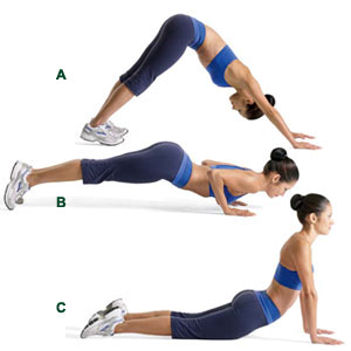
For Push-Ups, I aim for 100 total. I keep the number of reps per set around 7 to 10. As with Pull-Ups, I vary what type of Push-Ups I do. Mostly I do standard Push-Ups, but I also throw in Diamond Push-Ups, Hindu Push-Ups, and Push-Ups using the surprisingly effective Perfect Push-Up handles.

If I'm doing Goblet Squats, I do them on TGU day. I use a 44kg kettlebell and keep the numbers of sets and reps a bit low, because my legs have already gotten a workout from the TGUs. Plus, Goblet Squats are biomechanically a bit tricky for some one who is 6'3" with an inseam of about 36".

Tuesday, Thursday, Saturday

An arty Swing photo.
I do a Kettlebell Swing/Push-Up routine inspired by something I saw from coach Dan John. It's simple. Do 10 (or 15 or 20) Swings followed by 10 Push-Ups. Repeat the same number of Swings, but do 9 Push-Ups. Work your way down to just one Push-Up. Keep rests periods as short as possible. Right now I'm doing sets of 20 Swings with a 53kg 'bell, for a total of 200 Swings and 55 Push-Ups. When I'm done, I do 45 more Push-Ups to bring the total up to 100. (And no, I have not found that doing 100 Push-Ups a day six days a week leads to overtraining.)

After finishing my Push-Ups, I usually do a short core routine based on Dr. Stuart McGill's Big 3 Core Exercises.

I always start my workouts with a few minutes of meditation and some dynamic stretching. I always conclude with about 10 minutes of yoga based on the Eischens yoga sequence I learned at Monkey Bar Gym.

Tuesday, September 30, 2014

Back to Fitness Basics

Kettlebells are a fantastic training tool. Not only are they incredibly effective, but they are also a lot of fun and versatile. There are countless exercises you can do with them.

My cat Ziggy likes kettlebells, too.
Ironically, the fact that kettlebells are so fun and so versatile can pose problems. At least, they did in my case. I found myself changing up my kettlebell routines far too often, just because I wanted to try new things. While variety can be a good thing, it can also work against you. There's something to be said for doing the same things over and over. Consistency counts.

Swings in the park!
In an effort to cure by Kettlebell Attention Deficit Disorder (KADD?), for the past several months I've only concentrated on a few basic kettlebell and bodyweight exercises...
  • Push-Ups
  • Pull-Ups
  • Turkish Get-Ups
  • Swings
Monday, Wednesday, and Friday I do Turkish Get-Ups and Pull-Ups. 

Tuesday, Thursday, and Saturday I do Swings and Dr. Stuart McGill's Big 3 Core Exercises.

I do Push-Ups and about 10 minutes of yoga daily.

Occasionally, I'll throw something else into the mix; usually Goblet Squats. But the above has been the basis for my workouts for the last six months or so.

TGUs in a faux gangsta environment.
There's a reason I chose the exercises I did. They work. And doing them a lot and often makes them work even better.

Have I become bored? No. In fact, I've grown to love the grind of doing the same things over and over. There's something almost Zen-like about it.

Am I still getting results? If by "results" you mean getting stronger and leaner, then yes.

I plan to stick with the basics for the foreseeable future, adding moves such as Snatches and Goblet Squats here and there. But since I'm still improving, I have no intention of making any drastic changes anytime soon. As they say, if it ain't broke...


Tuesday, October 29, 2013

Sprints for Fitness, Fat-Loss, and Emergencies


At this point, it's old news: Sprints are good for you. As Men's Health sums up,  sprints are better than jogging for weight loss, heart health, and maintaining muscle.

From a practical standpoint, I would add that sprints are a more vital life skill then jogging. Think about  it... How many situations can you imagine finding yourself in that would require you to run at a moderate pace for three or more miles? Probably not many. How many situations can you imagine having to run at a high speed for a short  time? If you see a child about to walk in front of a car, my  guess is you'll sprint, not jog, into action. You may sprint to catch the bus. When possible, one of the best options for avoiding violence is to run away as fast as possible.

So sprinting is a good thing. What spring routine is best? Do a bit of research, and you'll get all sorts of answers. The Polinquin Group has a good rundown of a few options on their website.

One thing that many sprint routines inadequately address is rest periods. Sprinting is tremendously taxing. You need to have recovery time built into your workout. For shorter sprints lasting just 10 or 15 seconds, a good ratio of work to recovery is 1:3. If you sprinted for 15 seconds, you would rest for 45 seconds. And by rest I mean rest. Do nothing more difficult then walk around. No jogging, no  push-ups. Rest! If you are really going all out during the sprints, you won't be able to do much more.

Wednesday, June 19, 2013

Rest Periods for Ladders

Readers of this blog no doubt know I am a big fun of using ladders to get in lots of reps with little risk of overtraining. To reiterate how ladders work, here's an explanation from Clarence Bass:
Pavel pull-ups.
Here’s how Pavel describes the technique used by special forces personnel to work pull-ups into their busy classroom and training schedule: "We would file out to the pull-up bars and perform what we called ladders. I do a pull-up, you do one. I do two, you match me, etc. until one of us cannot keep up. Then, if we still had time, we started over. One rep, 2 reps, 3, 4, 5, 6, 7, 8, 9, 10... 1, 2, 3, 4, 5, 6, 7,... 1, 2, 3, 4, 5. We totaled hundreds of pull-ups almost daily without burning out, and the extreme PT tests of our service were a breeze.
Most of the time I train alone, so the question arises... How much do I rest in between reps?

My solution to this dilemma is pretty simple. I use a rough formula of 10 seconds rest per completed rep. So if I'm doing chin-ups, I will do 1 chin, count to 10, do 2 chins, count to 20, do 3 chins, count to 30, and so on. This is not a set-in-stone system, and sometimes my rest periods will be little longer or a little shorter.

While everyone should find a system that works for them, I find that this method allows me to do quite a few reps with good form.

Thursday, March 14, 2013

Chris Lopez on the 6 Essential Kettlebell Exercises


Chris Lopez is a great trainer with an informative blog. He has a good post on The 6 Essential Exercises of Kettlebell Training and How To Program Them Into Your Routine. His "Top 6" are...

-The Swing (1 arm & 2 arm)

-The Snatch

-The Clean

-The Squat

-The Military Press

-The Get-Up

All in all, a great list. Personally, I think the Long Cycle Clean & Jerk may be the ultimate kettlebell move, but that's a minor point. Chris's post is well-worth checking out.

Tuesday, March 5, 2013

Six Week Brazilian Jiu-Jitsu Conditioning Plan

My friend Travis is entering a Brazilian Jiu-Jitsu tournament in six weeks, and asked me to come up with a hardcore fitness plan.
Travis in action.

His main goals are conditioning and fat loss. He is already plenty strong. However, I've noticed he has some slight physical imbalances when it comes to pulling motions, which are important to a grappler. Six weeks before a tournament is not the time to seriously work on correcting this, so instead I incorporated a couple of simple moves to practice, not to "work out."

Most of the workouts are on the short side, as the main focus of someone preparing for a Jiu-Jitsu tournament should be Jiu-Jitsu.

For diet, my recommendations remain the same as what I posted here.

Monday, March 4, 2013

Things Are Going Swimmingly!

One of my favorite things to do on active rest days is to go on a nice ocean swim out to the wind sock off of Kaimana Beach. It's about 400-m or so there and back.

A couple of years ago, I could barely swim 40-m. A lap or two in a swimming pool left me exhausted. Basically, all I knew how to do in the water was 1. Not drown; and 2. Move from Point A to Point B... if Point A and Point B were pretty close together. In other words, I knew how to swim, but my form was awful.

So I decided to do something about it. After all, I live in Hawaii. I should be able to get full enjoyment out of the ocean. I started taking private ocean swim lessons from J.J. Kobelansky. In a matter of months my swimming improved dramatically as I learned proper body alignment, stroking, kicking, and (most important) breathing. While I won't be entering in roughwater swims in the near future, I am now at a point in which I can savor a nice, long swim in the ocean and come out feeling great and refreshed.

For anyone in Hawaii who wants to improve his or her swimming ability, I highly recommend J.J.'s Swim and Fitness. He is a supportive, good-natured teacher who specializes in the water-phobic. I believe even decent swimmers could benefit from J.J.'s instruction, as there is always room for improvement. He certainly helped me!

Monday, February 25, 2013

Men Training Women: It's About Trust and Respect


Read a forum post today about some bad gym behavior. Apparently, a trainer was training two young women and was trying to come on to one of them:
 “He obviously wanted to hit on the one girl so he ingratiated himself by ‘correcting’ her lat pulldowns - and in the process made her technique worse! Now her back exercise is a jerky, could-strain-her-shoulders bicep exercise.” 
To make matters worse, the above was followed-up with the following comment:
“..nothing wrong with hitting on a hottie. It's not her lats that he was interested in.” 
Here’s my response:

Under the circumstances, yes, it is wrong.

I am a certified fitness trainer and a martial arts instructor. To use my position to hit on a client during a training session would be unethical. A woman should be able to train in peace. Besides, in the situation described, the trainer sounds as if he was more focused on hitting on his clients than training them, which means he was essentially robbing them of time and money. Plus, he taught bad form, which is inexcusable.

This sort of training requires trust.
The relationship between a trainer and trainee is built on trust and respect. Consider that several of my friends and I teach Brazilian Jiu-Jitsu. Some of our students have been very attractive women. Few things are more physically intimate than BJJ, and it is hard enough to get a woman (or even a man, for that matter) to feel comfortable in some of the positions required without her worrying that the guy straddling her on the ground has ulterior motives.

This might be a shock for those who inhabit the juvenile wasteland known as “bro culture,” but plenty of women go to they gym to workout, get strong, and better themselves. They aren’t looking to be harassed by some horny jackass.

Wednesday, February 20, 2013

Conditioning with Hindu Push-Ups and Squats

Readers of this blog know I'm a fan of Hindu Push-Ups and Squats.

Recently, I've had a few people ask me about putting together a good conditioning routine based on theses two moves. Here are some thoughts...
  • 15/15s: Set a timer to go off every 15 seconds for at least 10 minutes. Do Hindu Push-Ups for 15-sec., rest 15-sec., Hindu Squats for 15-sec., rest 15-sec., etc. Don't worry about reps; just try to maintain a steady pace.
  • Escalating Density Training: Set a timer for somewhere around 10-20 minutes. Go back and forth between Hindu Push-Ups and Squats. Go at your own pace. Keep track of your total reps, and try to top that next time around.
  • Ladders: This one is real quick. Do 10 Hindu Squats and 1 Hindu Push-Up. Then do 9 Squats and 2 Push-Ups, etc., until you finish with 1 Squat and 10 Push-Ups. 
  • Another ladder variant: Do 1 Hindu Push-Up and 2 Hindu Squats. Than 2 and 4, 3 and 6, etc. until you start getting near failure. Then restart at the beginning.
  • For a really grueling workout, do 10 Hindu Push-Ups, 20 Hindu Squats, and 30 Kettlebell Swings. Repeat, resting as needed. When my friends and I do this one, we go to 11 sets, in honor of Spinal Tap.
Many of these workouts can be used as a warm-up or a finisher, or as a quick routine when you are pressed for time. Experiment, make changes, and create your own workouts. The possibilities are endless!