Showing posts with label Philosophy Thursday. Show all posts

Thursday, July 26, 2018

Philosophy Thursday: Good Men, Bad Men, Anger, and Thich Nhat Hanh

Buddhist monk Thich Nhat Hanh is in some ways a better human being than I am. Whenever I read his work, I am moved by his dedication to peace and compassion, and try to incorporate his teachings in my daily life. I strive to be a bit more like him.

But not too much like him. To put it bluntly, I'm an angrier person than Nhat Hanh, and I'm OK with that. He strives to surpass anger, to rise above it, while I—paraphrasing Capt. James T. Kirk—need my anger.

In his excellent book 'Being Peace', Nhat Hanh shares the following story:
After the Vietnam War, many people wrote to us in Plum Village. We received hundreds of letters each week from the refugee camps in Singapore, Malaysia, Indonesia, Thailand, and the Philippines, hundreds each week. It was very painful to read them, but we had to be in contact. We tried our best to help, but the suffering was enormous, and sometimes we were discouraged. It is said that half the boat people fleeing Vietnam died in the ocean; only half arrived at the shores of Southeast Asia. 
There are many young girls, boat people, who were raped by sea pirates. Even though the United Nations and many countries tried to help the government of Thailand prevent that kind of piracy, sea pirates continued to inflict much suffering on the refugees. One day, we received a letter telling us about a young girl on a small boat who was raped by a Thai pirate. 
She was only twelve, and she jumped into the ocean and drowned herself. 
When you first learn of something like that, you get angry at the pirate. You naturally take the side of the girl. As you look more deeply you will see it differently. If you take the side of the little girl, then it is easy. You only have to take a gun and shoot the pirate. But we can't do that. In my meditation, I saw that if I had been born in the village of the pirate and raised in the same conditions as he was, I would now be the pirate. There is a great likelihood that I would become a pirate. I can't condemn myself so easily. In my meditation, I saw that many babies are born along the Gulf of Siam, hundreds every day, and if we educators, social workers, politicians, and others do not do something about the situation, in twenty-five years a number of them will become sea pirates. That is certain. If you or I were born today in those fishing villages, we might become sea pirates in twenty-five years. If you take a gun and shoot the pirate, you shoot all of us, because all of us are to some extent responsible for this state of affairs.
While I certainly admire Nhat Hanh's ability to see the situation from the pirate's point of view, and can acknowledge the role of environment in shaping the pirate's life, this doesn't change my anger. When Nhat Hanh writes "If you take the side of the little girl, then it is easy. You only have to take a gun and shoot the pirate. But we can't do that..." I can't help but think, "Yes, we can. And should."

Perhaps Nhat Hanh is right that if I "had been born in the village of the pirate and raised in the same conditions as he was, I would now be the pirate. There is a great likelihood that I would become a pirate. I can't condemn myself so easily." I actually can condemn myself so easily. If I try to hurt an innocent, I deserve to be stopped. Think of the horror movie trope about the man bitten by a werewolf, who then turns into a werewolf himself and terrorizes the community. The cursed man, unable to bring himself to commit suicide, begs others to kill or imprison him. Or, to look at things more scientifically, consider the fact that brain tumors and injuries can cause serious behavioral changes. There have even been incidences of brain tumors being linked to pedophilia. Taking that as an example, if I ever develop a tumor and it compels me to try to rape a child, I hope someone stops me, even if it means killing me.

I can't help but think of the fascinating graphic novel 'My Friend Dahmer' by John "Derf" Backderf. It's the true story about growing up and going to school with future serial killer Jeffrey Dahmer. Even though Backderf shows some sympathy for the young Dahmer, in the book's afterward he clearly states
It's my belief that Dahmer didn't have to wind up a monster, that all those people didn't have to die horribly, if only the adults in his life hadn't been so inexplicably, unforgivably, incomprehensibly clueless and/or indifferent. Once Dahmer kills, however—and I can't stress this enough—my sympathy for him ends. He could have turned himself in after that first murder. He could have put a gun to his head. Instead he, and he alone, chose to become a serial killer and spread misery to countless people. 
I absolutely agree with that. There are times for compassion, and there are times for justice.

It's important to state that I don't consider Nhat Hanh's position to be wrong or unethical. I actually find it admirable. Quite possibly, if I could achieve his level of benevolent compassion, I would be a happier, "better" person. I just wouldn't be me.

To quote a great PiL song, "Anger is an energy." It motivates me. I wouldn't be a martial artist if it weren't for anger. I wouldn't teach self-defense classes if it weren't for anger. At the risk of sounding self-congratulatory, I think in my own small way I make the world a better place by teaching people to protect themselves while at the same time being able to protect them myself if necessary. Breaking someone's knee while simultaneously slamming face-down into the ground isn't very nice, but there are times it is necessary.
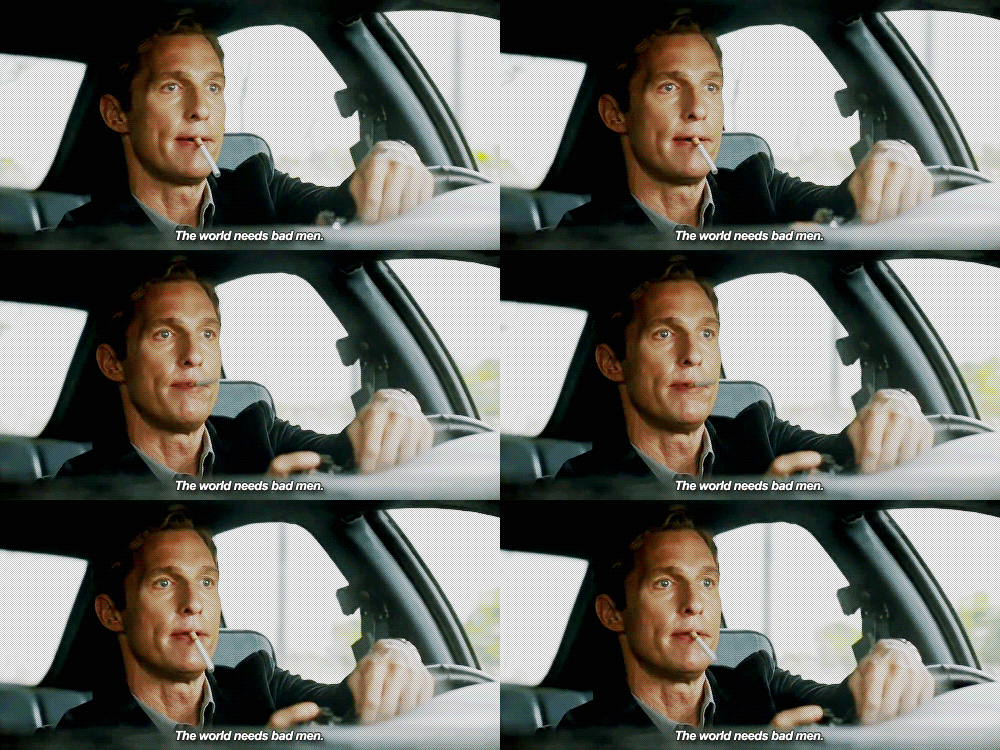
In season one of 'True Detective,' Matthew McConaughey's character Rush Cohle is asked "Do you wonder ever if you're a bad man?" He responds, "No. I don't wonder. World needs bad men. We keep the other bad men from the door." The show's creator and writer Nic Pizzolatto further elaborated on that concept in an interview: "Regarding bad men being necessary to stop the other bad men, that’s probably more true than I’d like it to be, but the point exists outside of gender: You need physically capable, courageous, and potentially violent people to deal with the violent, dangerous people."

Again, I absolutely agree. Compared to Thich Nhat Hanh, I am something of a bad man. And I totally accept that.

Thursday, December 29, 2016

Philosophy Thursday: So... Am I a Buddhist or Not?

Buddhism is a tricky thing. It can be a religion or a philosophy or both. It can be metaphysical or purely materialist. It can be laden with ceremony and tradition. Or not. 
 Because of this ambiguity, it can sometimes be difficult to decide if one should or should not refer to oneself as a Buddhist. This is doubly true if you happen to come from a non-Buddhist, Western cultural milieu. 
 I’ve been interested in Eastern thought and Buddhism in particular for many years. I first encountered Buddhist teachings when I was a teenager. My parents and I were staying at a hotel in Hilo, Hawaii. It was mid-afternoon, raining (as it often does in Hilo) and my parents were taking a nap. I had some time to kill but didn’t feel like braving the rain. On a whim, I looked in one of the drawers of the hotel room desk and found a Gideon’s Bible as well as The Teaching of Buddha. This is not uncommon in Hawaii. Some hotel rooms even have copies of the Book of Mormon. 
 Curious, I sat down and read the Buddhist book. I was impressed by the gentle, compassionate nature of the teachings therein. A seed was definitely planted in my being, but it was one that would take a long time to sprout. Soon after I discovered Buddhism I stumbled onto  Existentialism (thanks to a song by the Cure), and my philosophical excursions came to be dominated by Albert Camus, Jean-Paul Sartre, and Friedrich Nietzsche, with Gautama Buddha, Lao Tzu, and Confucius sneaking in here or there. Plus, in college, I took several courses about East Asian history, cultural, and thought, so Buddhism never was completely off my radar. 
 As I got older, I became involved in martial arts. I also found myself having to contend with the deaths of some people who I loved very much. It was around this point I started getting more serious about exploring Buddhism. I started reading the usual, classic authors—Alan Watts, D. T. Suzuki,  Christmas Humphreys, Thomas Cleary, etc.—before moving on to contemporary Buddhist writers such as Thich Nhat Hanh, Pema Chödrön, Yongey Mingyur Rinpoche, and others. 
At this point in my life I essentially accept the Four Noble Truths and try to live with a spirit of loving compassion. I meditate, though probably not enough. I’m a vegan who refrains from harming other sentient beings whenever possible. But can I really call myself a Buddhist?

 According to an article written by Dzongsar Jamyang Khyentse Rinpoche for Lion’s Roar, the answer is “Sorta.”

Thursday, July 14, 2016

Philosophy Thursday: A Buddhist Look at Death and Loss

I'm not really good with death. Over the years, I've lost one pair of great-grandparents, two pairs of grandparents, an aunt, my uncle, my mother, my father, my best friend, and too many animal companions to mention. While my losses don't compare with those who have survived wars, natural disasters, or other tragedies, it doesn't change the fact that every death of a loved one is painful. In the case of my mother, it was downright devastating.

Since I know dealing with even more death is inevitable, I try to find ways to prepare myself and accept the inevitable.

Some find solace in Abrahamic religious traditions, but that doesn't really work for me. It's not that the idea of Heaven isn't appealing. It is. I just can't quite make the leap of faith required to actually believe in it except in a vague sort of way.

On the other end of the spectrum, I don't fully accept the New Atheists and their denial of any transcendence either. 

Somewhere between the theist and the materialist lies the Buddhist, specifically the more philosophical, less religious Buddhism I find myself drawn to.

What do I mean by "more philosophical, less religious Buddhism"? As Stephen Batchelor explains in his book Buddhism Without Beliefs A Contemporary Guide to Awakening, it is quite possible to live in accordance to Buddhist philosophy without necessarily believing in karma, rebirth, the Pure Land, etc. Personally, I neither believe or disbelieve in those things. I just don't find them relevant to my daily life. 

The best book I have read so far about the Buddhist approach to death and dying is No Fear, No Death by Thich Nhat Hanh. This is a deeply compassionate work, as is every other book I've read by Nhat Hanh. Very early on, he outlines the basic idea that will inform the rest of the book:

Thursday, June 4, 2015

Philosophy Thursday: On Truth

Note: I was going through some old files and stumbled on to this essay I wrote in 2010. Oddly, I don't actually recall writing it, nor am I a sure why I wrote it in the first place. I think it was in response to someone who asked me about my view on the idea of "truth." Or maybe not. Either way, it remains an accurate reflection of my thinking.

It was an almost normal photograph of an almost normal little girl. Two things make it abnormal. One was the black bar superimposed across her eyes to hide her identity. The other was her right arm, which ended at her elbow. I was a child when I saw the photograph, probably only a bit older than the girl herself, who was five. It was in one of my mother's medical books. She was attending nursing school at the time, and there were journals and textbooks scattered throughout the house. I often looked through them, amazed by the pictures of skeletons and nervous systems and patients with weird maladies. My mom didn't care, as she was pretty progressive and didn't believe in hiding anything from me. When I stumbled onto the photo of the anonymous, one-armed little girl, I asked what had happened to her. Taking the book from me so she could read the text I was too young to read myself, my mother hesitated a moment before answering. "The little girl was told to keep out of the peanut butter. When she didn't listen, her father put her arm in a vice and sawed it off." Some people have all sorts of moral truths: taxation is theft; abortion is murder; don't mix meat and dairy; and so on. Not me. Most of mine are pretty basic. Perhaps the most basic comes from viewing that awful photo years ago: Do not be cruel to the weak.

Thursday, March 19, 2015

Philosophy Thursday: On Nihilism

I was thinking to myself, "What does this blog need more of? Of course! Pretentiousness! And navel-gazing!" And thus Philosophy Thursday was born. 

In all seriousness, I have long been interested in philosophical matters. I actually considered majoring in philosophy in college, but opted for history instead under the mistaken assumption that it was a better choice from a professional standpoint.

A couple of caveats: One, I make no claims of being some sort of expert on philosophy. I am a layman. A reasonably well-informed layman, but still layman. Two, my approach to philosophy is very personal and subjective. Some of my views may be confusing, troubling, or even offensive to some readers.

With that, please enter freely and of your own free will!

To kick off Philosophy Thursday, I want to look at the cheery subject of nihilism. What is nihilism, or better yet, what is a nihilist? For the purposes of this post, I'm going to go with Friedrich Nietzsche's definition: 


A nihilist is a man who judges of the world as it is that it ought not to be, and of the world as it ought to be that it does not exist. 

I tend to simplify this by saying a nihilist as one who thinks that the world that should exist doesn't, and that the world that does exist shouldn't. 
 Sounds like a rather dark way to view existence. I should know, as I've struggled to resist the lure of nihilism most of my life.

That statement might sound a bit melodramatic, but it's true.